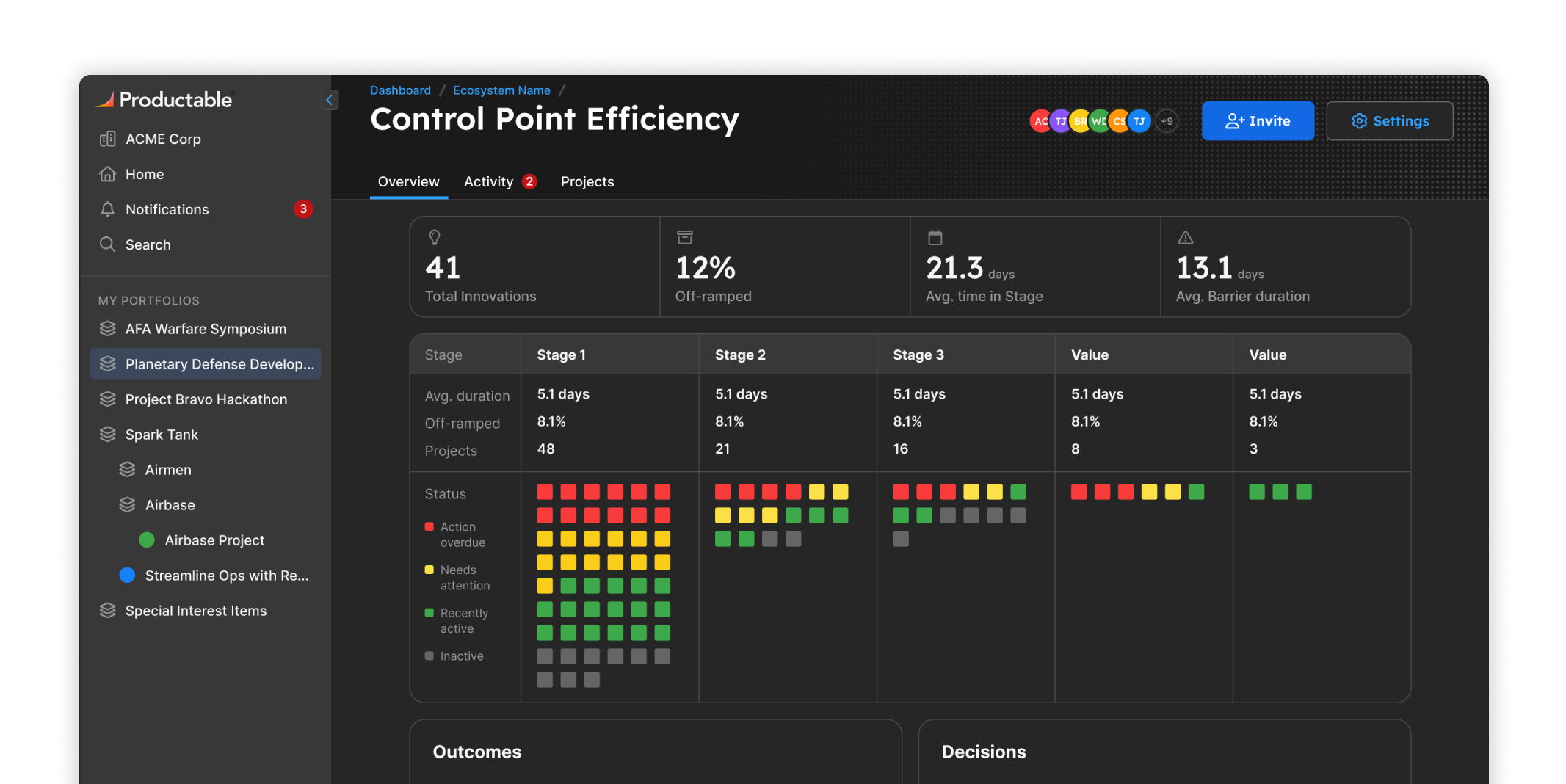
Enabling innovation at scale for federal defense agencies
Productable
- Government
- Early stage
- Management
- B2B
- Research
- Strategy
- Visual design
- Prototyping
- Design systems
Summary
My team joined (through an acqui-hire) only weeks before an app was due to the Airforce under contract.
My team created a frontend design system, re-coded the app, configured a secure IL4 government cloud environment, and delivered on time. I’m really proud of that.
Post launch, I helped refine product & business strategy and refine our understanding of our customer base. I began to build up a team while continuing to deliver targeted experiences.
The Product
Productable is a startup building innovation management software. The founder/CEO has 10 years of consulting experience helping companies create internal innovation pipelines and incubators. This software captures her methodology in a more accessible way for any team that needs to innovate at scale.
First problem: delivering an app on a deadline
Productable had a rudimentary low-code app but needed to improve it to meet a spring deadline to deliver a fully working app in an Impact Level 4 (IL4) environment to the Air Force. The in-house product and design teams weren’t communicating well with contract developers, and they were far behind schedule.
My small startup team was acquired by Productable a few months before the deadline.
Goals
- Develop an app to deliver to the Air Force.
- Create it within 10 weeks using best practices in the tech stack and design system.
- Meet all the contract requirements and criteria.
My impact
(More on each of these below)
- Information Architecture audit
- 0-1 design system
- UI designs
Information architecture audit
Within the first week, I met with three or four members of the new team. No one could clearly explain to me how the app worked. I began using diagrams as a way to communicate so they could tell me where it was wrong, or what I got right.
{: .image-container }
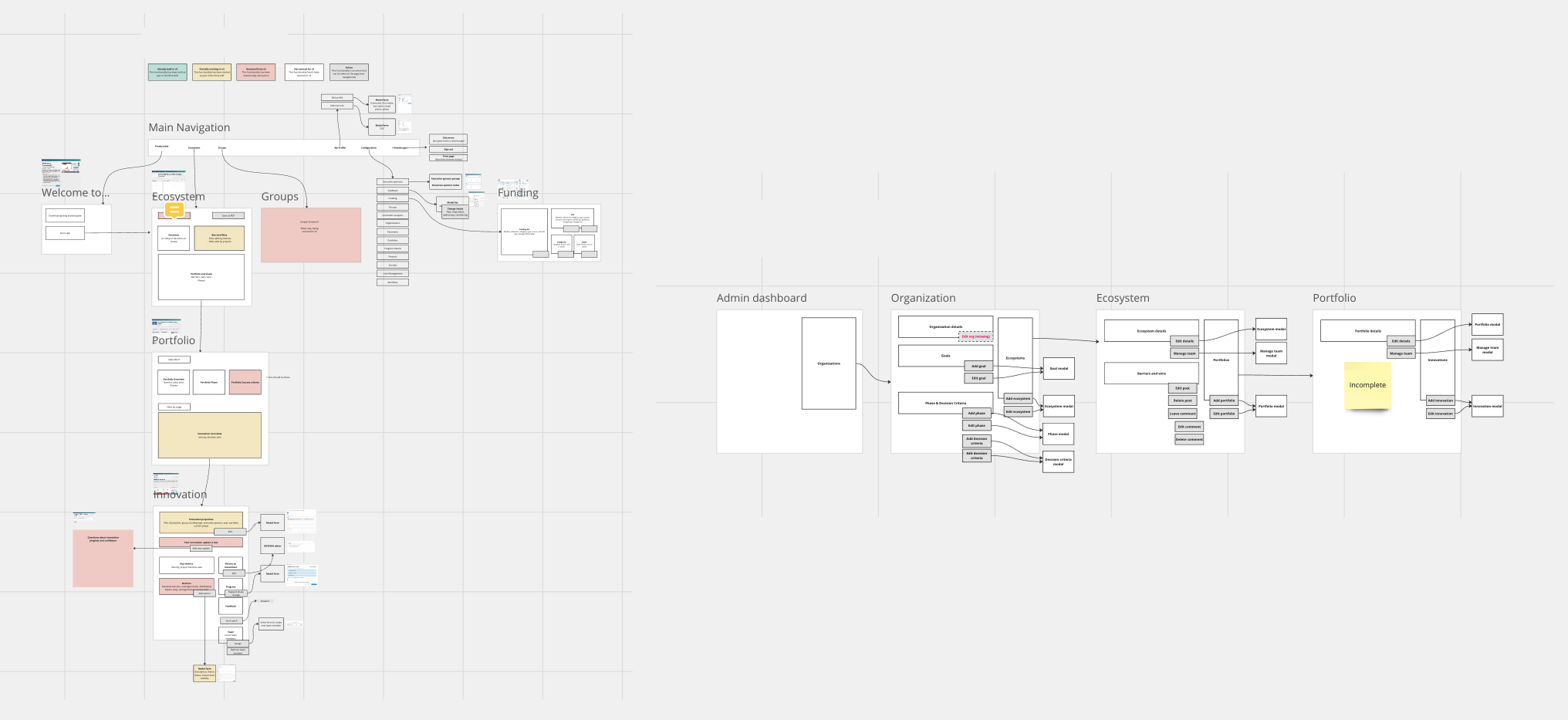
I audited what existed, then modeled the ideal architecture to generate alignment from the team. This helped in many ways:
- Forced clarity in team discussions
- Helped organize the work around feature-centered epics and stories*
- Stabilized the underlying model for upcoming UI design work
- Note: I believe that work should be organized around outcomes, not features, but worked this way for the sake of hitting a deadline.
0 ➡ 1 design system
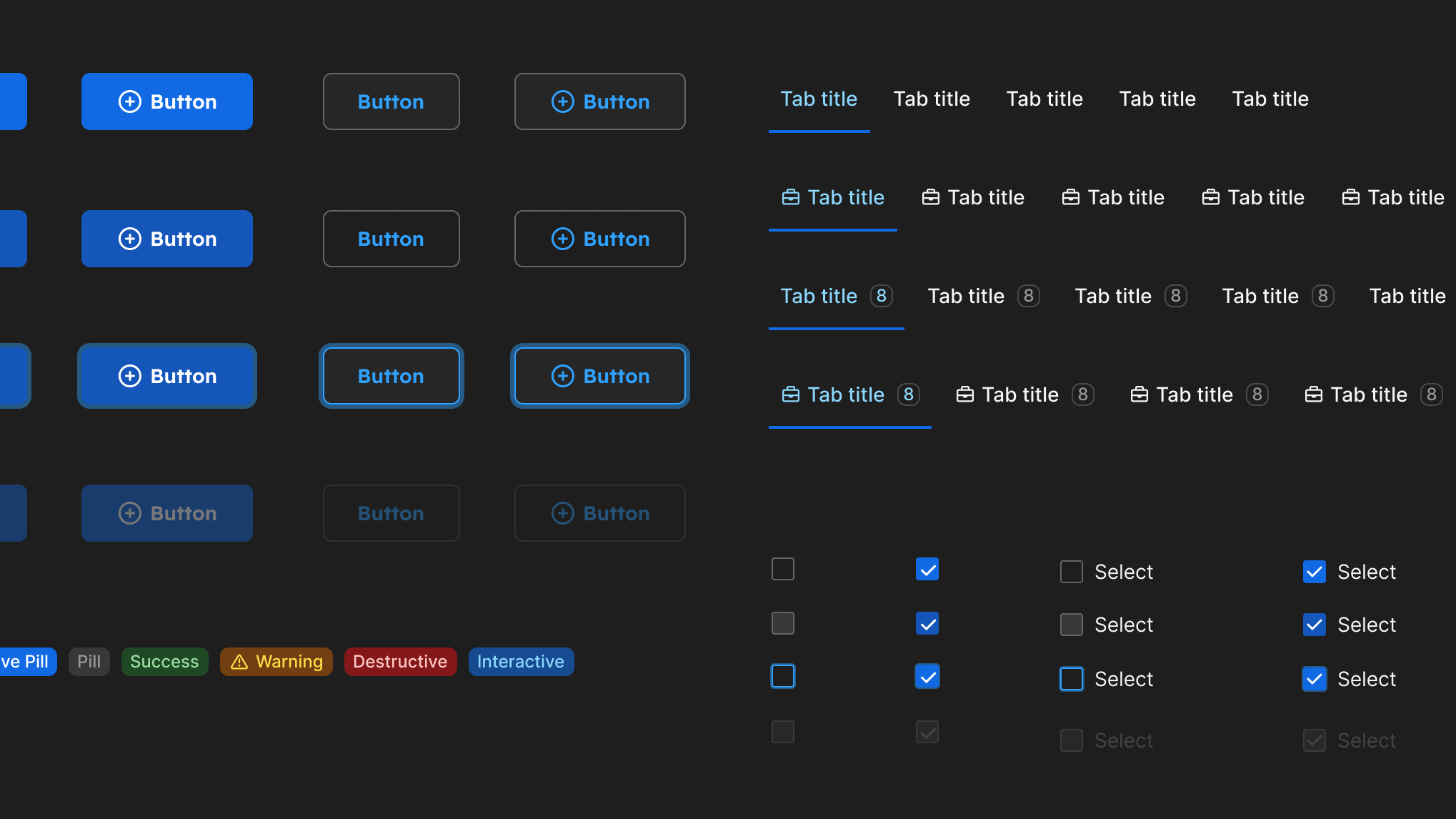
I have created rapid design systems for teams about six times now. I follow a similar process each time, which you can read more about here. Essentially:
- Audit any existing apps, wireframes, or concepts
- Collaborate with engineering to understand the tech stack, existing libraries, and constraints
- Create a component list
- Create a framework for each component to follow (states, styles, accessibility, etc.)
- Break tasks into groups to divide among the design team or prioritize for myself
- Prioritize the most commonly used components
- Build out all components within the framework
- Follow closely along with engineering as they build out components in code
- Create a review cadence to regularly revisit components with engineering in the future
This was the fastest I’ve ever been able to do this. From start (auditing) to finish (implemented in code) it took 3 weeks.
{: .image-container }
UI design to solve real problems faced by portfolio owners
Delivering the MVP app with a shiny new tech stack didn’t result in an immediately high-quality UX. Sales team members complained that the app wasn’t telling the clear story of “So what?”. They were itching for designs that clearly showcased the value of the app in a quick demo format.
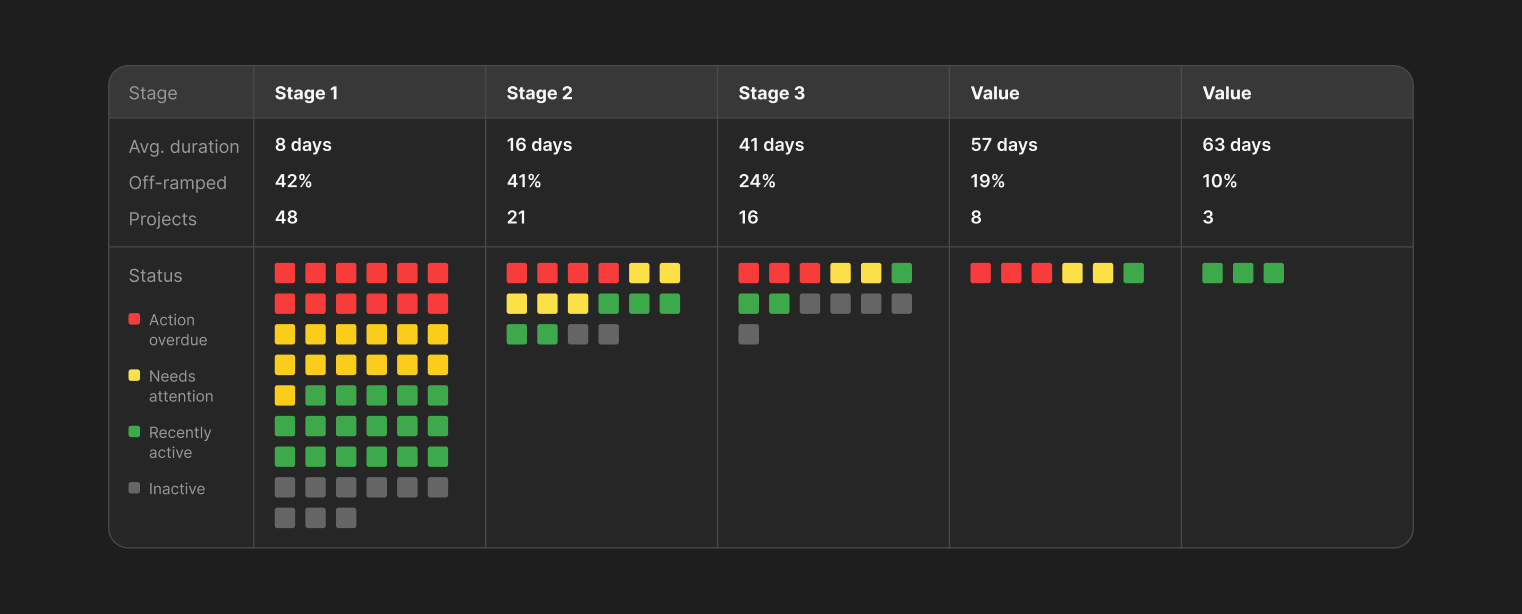
I collaborated with stakeholders and advisors to develop a new visualization within the app (we called it “the stoplight chart”) that quickly showed portfolio performance at-a-glance. Each colored square represents the status of one project within a portfolio.
{: .image-container }
Qualitative feedback about this effort:
- One customer, after seeing it, said, “Great work, I love it. It really answers the mail for what a lot of our customers are going to want to see.”
- One advisor, an SME in the space, said, “This to me is substantially more valuable for two reasons: 1. I’ve been doing this for quite a while [and this is how I think about things], 2. I understand this much more in-depth. … it’s helpful that I can see the shape of the funnel.”
- The CEO, in a personal setting, said, “You’ve been able to put on the screen what’s been in my head for years.”
This one feature has quickly become the main face of our marketing efforts and is shown in various settings on our webpage and sales materials.
Second problem: setting the team up for success
Now that we had an app, we needed to set ourselves up for future success. The company was not set up to be a software company. We lacked a vision, a product strategy, or alignment between departments. We weren’t clear on who we were designing for nor how we would gain that focus.
My impact
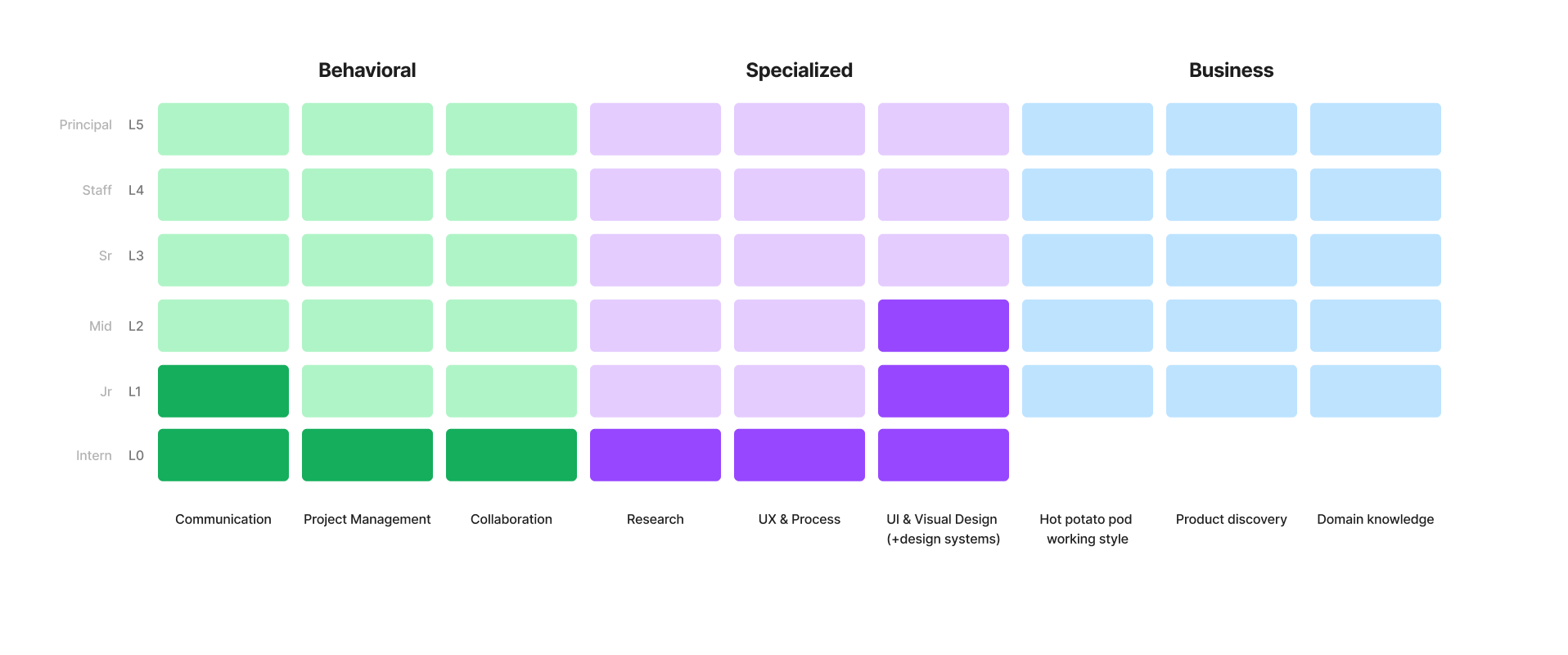
- Restructuring the design team
- Driving leadership alignment
- Experiments with feedback funnels
- Exposing gaps in user understanding
- Maturing the brand
Restructuring the design team
A Head of UX was at the company when I arrived. We worked alongside each other for several weeks. That former Head was let go, and I was moved into his position.
I inherited a very junior designer who wasn’t delivering value to the company. I set up a performance plan to help this designer through the summer. I met with them regularly to guide projects, give feedback, and assess growth. When this designer didn’t show initiative throughout this trial period, I made the difficult decision to let them go.
((Insert photo of growth matrix thingy))
I sourced, interviewed, and hired a Senior Product Designer. They had extensive startup experience and were up to the challenge of working through the existing ambiguities within the company (that I would continue to work on fixing).
{: .image-container }
Driving leadership alignment
The VP layer of the company included team members from consulting, government, and other backgrounds that didn’t all have a shared context for running a software company. I helped drive a few efforts to improve the overall information sharing and culture of the company, including:
- Leadership team retrospectives to understand and improve communication processes
- A regular leadership meeting cadence and agendas
Experiments with feedback funnels
Part of designing a highly niche federal app privatized behind layers of secrecy is a limited number of users to give product feedback. At this early stage, the company needed to be Sales led to establish a financial footing before we shifted to product-led growth. A few efforts I helped drive to try and solve this problem:
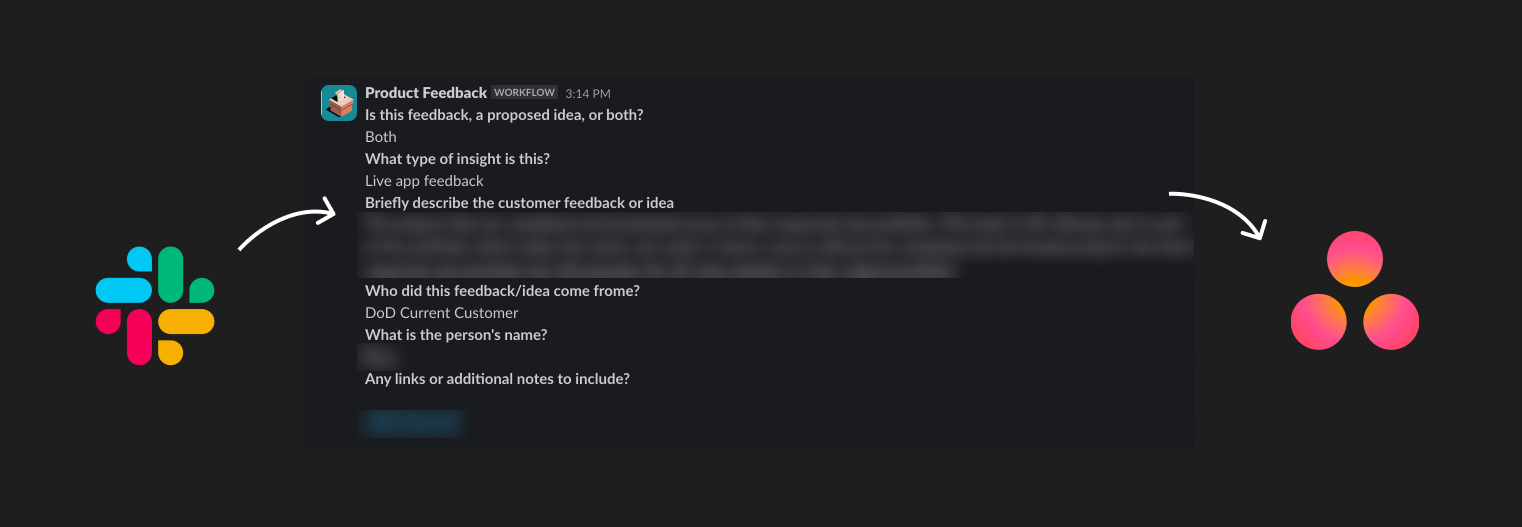
- A Slack “product feedback” channel that used a Slack shortcut to drop tasks directly into Asana. We then prioritized and reviewed the tasks on a bi-weekly cadence.
- Occasional interviews with early users to understand pain points
- A monthly “stakeholder input” meeting where we collaboratively prioritized potential roadmap items based on anecdotal sales and market feedback
- Joining in on Customer Success calls to listen to training, hear questions, and field product questions
- (Haven’t yet tried) Product and design team members attending federal conferences to meet prospects and learn the language of the DoD
The team is preparing for several hundred new users to enter the platform, which will allow us to experiment with new feedback methods, such as in-product surveys and product analytics.
{: .image-container }
Exposing gaps in user understanding
While interviewing Air Force users, I uncovered some anxieties around innovator participation in our product. These were further confirmed with a different wing of the Air Force when collaborating with the Success team training. Some of the concerns that arose:
- The innovators for the Air Force (often Airmen, who are 18 and fresh out of school) are not well connected to higher-level processes.
- Limited computer access while working on a plane or an airbase.
- No CAC/IL access that would give them access to secure government cloud environments.
I was disappointed to have uncovered this concern several months after joining the company as a result of the business strategy relying on the CEO’s personal convictions.
At the time of writing, we’re still monitoring onboarding users and discussing shifts in our product strategy as a result of these concerns.
Maturing the brand
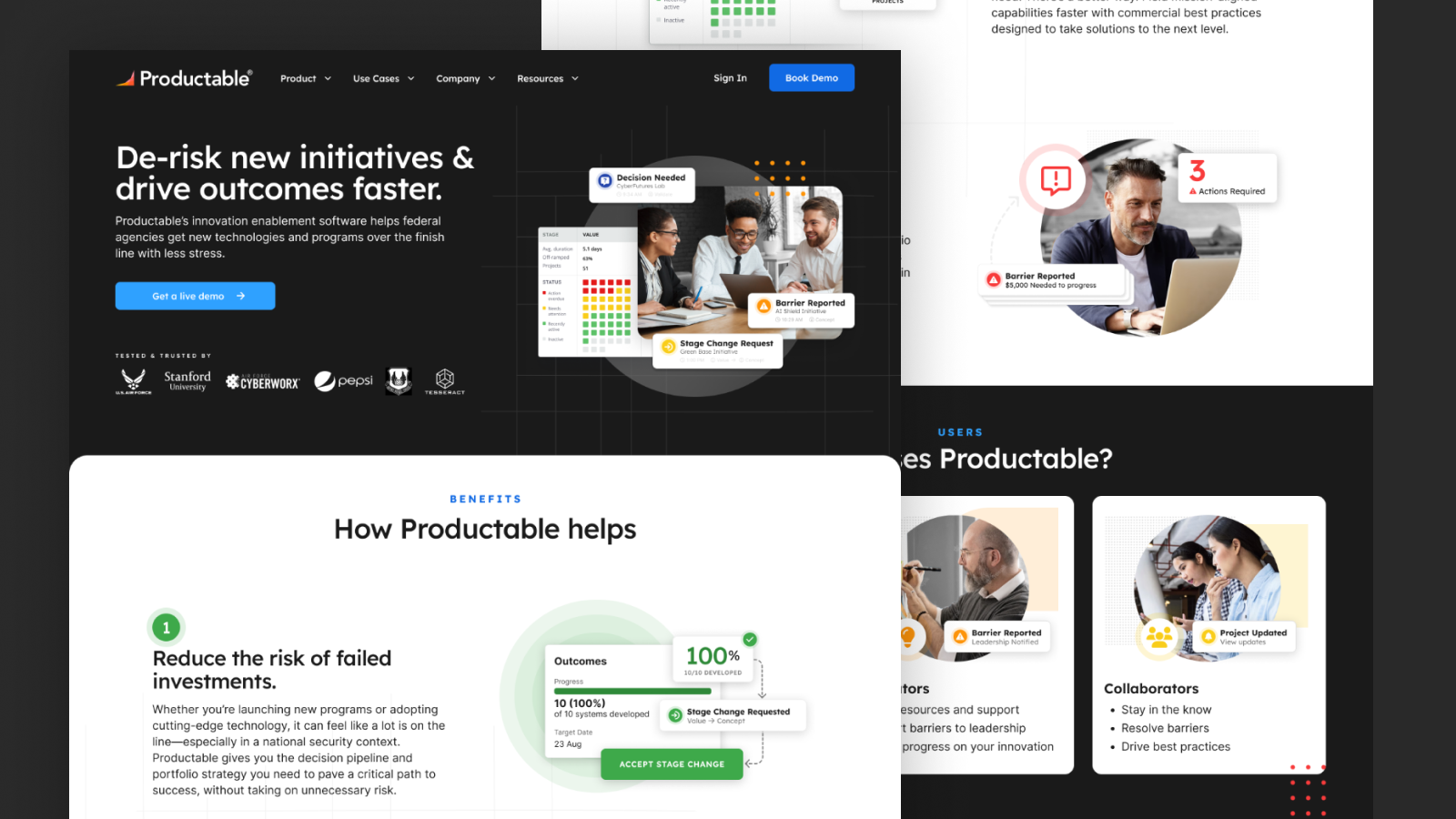
Before I joined, the org had spent somewhere around $30k for a limited package of dated illustrations and low-quality color palettes. I pushed for the refresh of our brand package and was met with some resistance due to the scar tissue from past rebrands.
I orchestrated a short brand refresh sprint to mitigate some of those concerns while leaning on the Senior Product Designer I hired to do most of the visual rework. Some of the processes that helped with this were:
- A kickoff with clear goals and success criteria
- A short, planned timeline
- Regular check-ins and design reviews
We leaned into some more common brand patterns within the space instead of designing something too avant-garde. We simply needed a more mature foundational brand we could evolve going forward, and to shed our low-quality brand elements.
{: .image-container }
Lessons learned
- Early team members have an outsized impact on company success. Hiring any product or design person off the street doesn’t mean they can help a startup win. This is a special flavor of quick, iterative, reactive product and design that not everyone knows how to do.
- Frequent customer touchpoints are required for product direction. This is design 101, but you feel it acutely when your access to customers is limited. Any time we lost this thread we found our product roadmap beginning to lose focus.
- Mergers and acquisitions are very difficult to pull off. We faced challenges with team culture, personalities, and especially alignment with the company vision. If team members don’t believe in the mission of the new company, it’s rare that they will stay for very long.